
Slope for drainage pipe as per IS code: Why Drainage Pipe Slope Matters 🙂
In any drainage system, slope (or gradient) is what creates the natural push that allows wastewater to move smoothly through the pipeline. If the slope is too flat, water stagnates and solids settle inside the pipe, causing choking. If the slope is too steep, water flows too quickly while solids stay behind — leading to frequent blockages. 😬🚫
A correctly designed slope ensures self-cleaning velocity, meaning the pipe flushes itself naturally without requiring constant maintenance. This improves hygiene, reduces manual cleaning, and increases the lifespan of the entire drainage network. 🚀🔄
Slope for drainage pipe as per IS code: What the Standards Say 📘📐
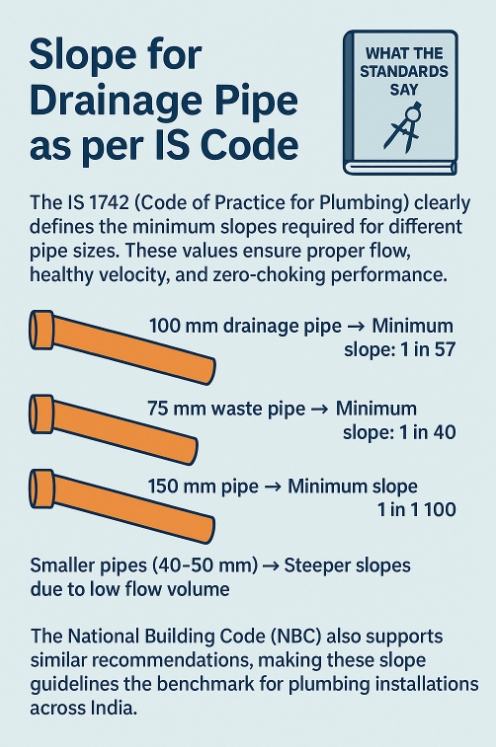
The IS 1742 (Code of Practice for Plumbing) clearly defines the minimum slopes required for different pipe sizes. These values ensure proper flow, healthy velocity, and zero-choking performance.
Here is a simplified guide based on the standard:
-
100 mm drainage pipe → Minimum slope: 1 in 57
-
75 mm waste pipe → Minimum slope: 1 in 40
-
150 mm pipe → Minimum slope: 1 in 100
-
Smaller pipes (40–50 mm) → Steeper slopes due to low flow volume
The National Building Code (NBC) also supports similar recommendations, making these slope guidelines the benchmark for plumbing installations across India. 🇮🇳🏗️
By following the correct slope for drainage pipe as per IS code, you ensure that the system works efficiently for years without recurring issues.
Importance of Correct Slope in Daily Plumbing 🏢💧🙂
A properly maintained drainage slope leads to:
-
Smooth and uninterrupted wastewater flow 🚀
-
No sediment buildup inside pipes
-
Reduced chances of choking and foul smell
-
Lower maintenance costs
-
Better performance of bathroom fixtures, kitchens, and floor traps
-
Longer pipeline life due to reduced internal pressure
-
Cleaner and healthier environment inside the building 🌿
Incorrect slope is one of the top reasons for plumbing failures, so following standards is non-negotiable.
Where Proper Drainage Slope Is Most Critical: Slope for drainage pipe as per IS code 🛠️🏙️
Correct slope plays a crucial role in all types of plumbing networks:
-
Vertical and horizontal drainage lines
-
Bathroom and toilet pipelines
-
Kitchen sink and waste lines
-
External drainage networks
-
Basement drain systems
-
Underground sewer lines
-
Rainwater drainage systems
Each of these systems needs precision on-site to ensure long-term performance.
Common Mistakes on Construction Sites 🚧⚠️
Many plumbing issues begin during installation because slope was not measured properly. Some common mistakes include:
-
Relying on visual judgment instead of instruments
-
Over-sloping pipes causing solids to settle
-
Improper pipe supports leading to sagging
-
No level or laser checks during installation
-
Incorrect routing through beams or tight shafts
-
Inconsistent slope throughout the pipe length
These mistakes often become expensive maintenance problems later — something no client wants. 💸😓
Why SSES Engineers Is the Best SITC Partner for Plumbing Systems 👷♂️💙🔥
When it comes to maintaining slope for drainage pipe as per IS code, precision is everything — and that is exactly what SSES Engineers is known for.
SSES Engineers is one of India’s leading plumbing contractors/vendors specializing in SITC (Supply, Installation, Testing & Commissioning) of complete plumbing systems. We are not manufacturers, which means we recommend the right materials purely based on project needs — without bias. ✔️🔧
Why Clients Prefer SSES Engineers:
✨ Highly skilled team trained in IS & NBC standards
✨ Perfect slope checking using laser levels for accuracy
✨ Zero-choking installation methods
✨ Best support systems: clamps, hangers, rods, couplers
✨ Strict adherence to engineering designs & checklists
✨ Professional documentation: BOQ, WIR, MIR, checklists
✨ Experience across high-rises, commercial towers, hotels & industries
✨ On-time delivery and excellent workmanship
From drainage lines to vent lines, bathroom plumbing, external sewage networks, and underground pipelines, SSES Engineers ensures flawless execution for every project. 🏗️💯
Quick Formula to Calculate Slope On-Site 📏🧮
A simple way to calculate slope is:
Slope (%) = (Vertical fall ÷ Horizontal length) × 100
Example:
A 10-meter line with a 1 in 57 slope requires a vertical fall of:
10 ÷ 57 = 0.175 m → 175 mm
This helps plumbers maintain accuracy throughout the line.
Final Thoughts 🌟💧
A well-functioning plumbing system begins with the correct slope for drainage pipe as per IS code. When slope is designed and installed correctly, the drainage system remains smooth, hygienic, and reliable for decades. On the other hand, any compromise in slope leads to repeated blockages, foul smell, leakage, and costly repairs.
This is why choosing an expert SITC plumbing vendor like SSES Engineers makes all the difference. With our technical expertise, precision installation, and commitment to IS & NBC standards, we ensure your drainage system performs at its best — always. 🚀👷♂️✔️